
How to save money on your energy bills and what support there is to help you pay the bills
On this page
- What's happening to energy bills from 1 October 2026?
- What financial help is available towards energy bills and the cost of living?
- Tips to help you save energy
- How to get advice
What’s happening to energy bills from January?
Ofgem have set the energy price cap for 1 October to 31 December 2026. This means that from 1 October a household with a typical consumption on dual electricity and gas will pay the equivalent of:
- £1,678 a year if you have a prepayment meter
- £1,723 a year if you pay by direct debit
- £1,861 a year if you pay on receipt of a bill (standard credit)
Please note there is no VAT on electricity from 1 October 2026 to 31 March 2027 and prices are worked out per unit of energy used. If you use more you will pay more. The exact rate and standing charge will depend on the region where you live.
What is the Energy Price Cap?
The Energy Price Cap, which is set by the energy regulator Ofgem, is the maximum amount your supplier can charge you for a single unit of gas or electricity if you’re on a standard variable tariff.
How this affects what you’ll pay for gas and electricity depends on the tariff you’re on. If you're not sure what tariff you're on, check your energy bills or contact your energy supplier.
If you're on your supplier's 'default tariff', this is the same as a standard variable tariff. You’re probably on a default tariff if you haven’t switched suppliers in the last year, or you’ve never checked what tariff you’re on.
If you’re on a standard variable tariff
From 1 October 2026, the average energy bill for a household on a default tariff, or standard variable tariff, paying by direct debit will be around £1,723 per year but remember even if you are on a default tariff your bill will be determined by how much energy you use, so if you use more gas or electric your bill will be more than £1,723.
You can find more information about the Energy Price Cap and how it affects you, on Ofgem's website.
If you’re not on a default / standard variable tariff, for example you’re on a fixed tariff or a time-of-use tariff then contact your supplier to check how your bills will change after 1 October 2026.
What support and financial help is still available towards energy bills and the cost of living?
There are no new Cost of Living support payments from the Government now but there is still help available if you’re struggling to afford your energy bills, or top up your prepayment meter. You might also be able to get certain benefits, grants and help offered by the government and energy suppliers.
Warm Home Discount: This gives you money off your electricity bill if you’re on a low income.
If you get benefits, you might be able to get £150 off your electricity bill or £150 added to your prepayment meter. You don’t need to apply for the scheme - payments are automatic.
Check with your supplier to see if they offer the Warm Home Discount because not all of them do. You can only get the discount if your supplier is in the scheme.
The Warm Home Discount Scheme is closed over the spring amd summer. It will reopen in October 2026. If you got the Warm Home Discount last winter and your situation hasn’t changed, you should get it again this winter.
If you didn’t get it last winter, you should check if:
- you’ll be eligible this year - it's based on any benefits you get
- your supplier is part of the scheme.
Winter Fuel Payment: If you or someone in your household has reached State Pension age, you might be eligible for a Winter Fuel Payment. This is an annual one-off payment to help you pay for heating during the winter.
For Winter Fuel Payments, you'll get a payment for winter if:
- you've reached State Pension age, and
- your income is up to £35,000 a year.
If your income is over £35,000 a year, you'll still get the Winter Fuel Payment - but the government will take back the money through your taxes.
Your household will get either £200 or £300 - this depends on your age. The money will be paid automatically.
- If you or your partner is under 80 years old, your household will get £200.
- If you or your partner is 80 or over, your household will get £300.
Each household will only get one payment.
If you’re eligible for a Winter Fuel Payment, you’ll usually get a letter in October or November each year saying how much you’ll get. You’ll usually be paid automatically in November or December. Claims for winter 2026 to 2027 open from 21 September 2026.
If you don’t get a letter by early December and you think you're eligible for a Winter Fuel Payment, you can make a claim. Check how to make a claim for a Winter Fuel Payment on GOV.UK.
Cold Weather Payments: Cold Weather Payments are one-off payments to help you pay for extra heating costs when it’s very cold. You’ll get a payment each time the temperature drops below a specific temperature for a set period of time. You’ll only be eligible for a Cold Weather Payment if you already get certain benefits. If you're eligible, you should get paid automatically. Find out more about Cold Weather Payments on GOV.UK.
Get support from your energy supplier: Call your supplier and ask them if they offer any grants to help with your energy bills. Even if you’re not eligible for grants, suppliers still need to support you to manage your payments based on what you can afford. Depending on your circumstances, they may also offer you a referral for independent debt support or energy efficiency advice. They may also be able to offer you temporary credit for your prepay meter that you’ll need to repay.
You can find more details about Grants and benefits to help you pay your energy bills - on the Citizens Advice website.
Local energy grants and support
Surviving Winter Grant: The Surviving Winter grant can provide households with £200 to help with winter fuel costs. Grants are made from funds raised by the Wiltshire Community Foundation’s annual Surviving Winter campaign. If you are of pensionable age or have a long-term health condition which is exacerbated by the cold weather and are on a low income you may be eligible for support through the Surviving Winter programme. To find out more please contact:
- Age UK Wiltshire - if you are of pensionable age on 0808 196 2424
- Warm and Safe Wiltshire - if you are working age on 0800 038 5722
Fuel vouchers: If you can't afford to top up your prepayment meter you might be able to get a fuel voucher. You can contact us at Wiltshire Citizens Advice for more details about this. We can also help with food bank vouchers too.
Warm and Safe Wiltshire: Helps residents live in warmer, safer and healthier homes. The energy advice line for Warm and Safe Wiltshire is provided by the Centre for Sustainable Energy on behalf of Wiltshire Council. They offer offer support for energy efficiency measures, such as draught-proofing and wall insulation and provide fuel poverty support for those most in need. You can find out more about how Warm and Safe Wiltshire can help you on Wiltshire Council's website. Eligible residents can contact Warm and Safe Wiltshire on 0800 038 5722 or email This email address is being protected from spambots. You need JavaScript enabled to view it. .
Local Crisis Support: Wiltshire Council has a crisis payment scheme, as part of the Crisis and Resilience Fund. Crisis Payments are usually one‑off, short‑term payments. The amount awarded depends on your individual circumstances. A Crisis Payment is a discretionary payment to help with essential costs if you are experiencing a financial crisis. You may be able to get help if you are struggling to pay for things like:
- food
- energy or fuel
- essential household items
- other urgent living costs.
For full details, or to apply visit: Wiltshire Council's website.
Heating Oil Support: If you use heating oil and are struggling to pay for a delivery, you may be eligible for support from Warm & Safe Wiltshire, a service provided by Centre for Sustainable Energy. This help is available to households facing an urgent financial difficulty related to heating oil costs. For details of eligibility and to apply visit: Warm & Safe Wiltshire: Wiltshire CRF Oil Support Application
Is there anything more I can do to save money on energy?
There are some simple things you can do to save some money on your energy bills. They won’t cover all the extra costs, but they can make a difference.
Energy saving tips
Here's our five tips:
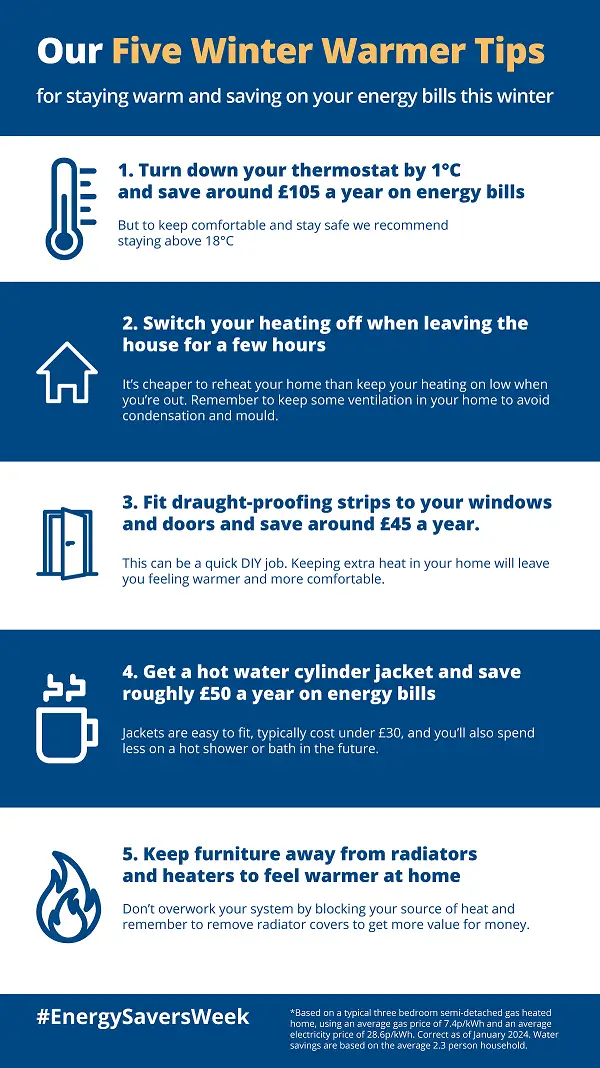
1. Turn down your thermostat by 1°C and save around £105 a year on energy bills.
But to keep comfortable and stay safe we recommend staying above 18°C.
2. Switch your heating off when leaving the house for a few hours.
It’s cheaper to reheat your home than keep your heating on low when you’re out, unless you own a heat pump.
3. Keep the heat in: Fit draught-proofing strips to your windows and doors and save around £45 a year.
This can be a quick DIY job. Keeping extra heat in your home will leave you feeling warmer and more comfortable.
4. Get a hot water cylinder jacket and save roughly £50 a year on energy bills.
Jackets are easy to fit, typically cost under £30, and you’ll also spend less on a hot shower or bath in the future.
5. Keep furniture away from radiators and heaters to feel warmer at home.
Don’t overwork your system by blocking your source of heat and remember to remove radiator covers to get more value for money.
For more tips on saving energy, visit the Energy Saving Trust website.
Need advice?
We know this is a stressful and worrying time. We’re encouraging people to consider small ways they can make savings at home wherever possible and make sure they’re getting all the support they’re entitled to.
If you’re struggling, worried you might not be able to afford to top up your meter, or pay your bills, or are having any issues with your energy supplier, don’t hesitate to contact us so that we can help you find a way forward.
Call us on freephone 0808 278 7995 (Monday to Friday 9am to 4pm) or email us for support and advice.
First published 9 January 2024.
Updated 9 April 2024, 2 July 2024, 27 August 2024, 1 October 2024, 2 January 2025, 31 March 2025, 17 June 2025 14 July 2025, 29 September 2025 5 January 2026, 22 May 2026, 3 July 2026 and 28 September 2026.